My First Blog Post
I Couldn’t Unknow It: Why I’m Fighting for Air Conditioning in Florida Prisons
By Connie Edson
Inside the Heat | Degrees of Humanity
I did not set out to become an advocate for air conditioning in Florida correctional facilities. I became one because someone I loved was living inside a Florida prison without air conditioning, and once I understood what that meant, I could not look away.
At first, I thought it had to be an isolated problem. Maybe one dorm. Maybe one building. Maybe one facility. But as I started asking questions and doing the research, I learned that the lack of air conditioning was not unusual. It was the norm. In 2023, Florida Department of Corrections Secretary Ricky Dixon told lawmakers that 75% of prison housing units in Florida did not have air conditioning.
That number should stop all of us. This means that more than 65,000 people may be living in Florida prison housing units without air conditioning. Florida’s prison system houses nearly 89,000 people, and roughly three-quarters of its housing units lack A/C.
Heat inside prison is not a comfort issue. It is a health issue. It is a safety issue. It is a human dignity issue.
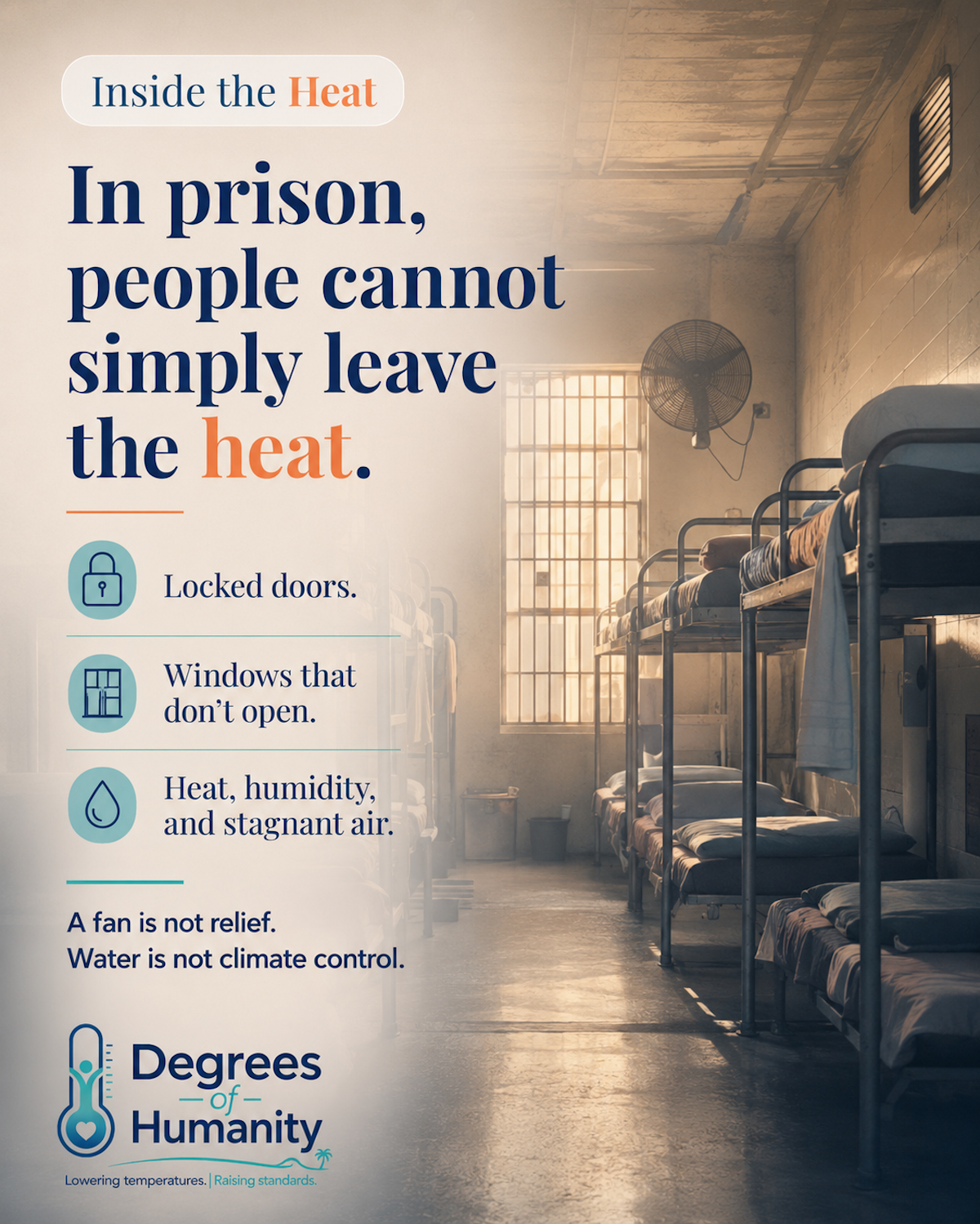
People often think of air conditioning as a luxury because most of us experience heat from a place of choice. Even during an emergency we can step inside. We can take a cold shower, open a door, sit in our car, or leave a room that feels unbearable. In prison, people cannot simply leave. The doors are locked. The windows if there are any, don't open. The building itself traps heat, humidity, and stagnant air. It is suffocating.
Public reporting, the formerly incarcerated, and even the correctional staff have described the only respite being able to lay still to avoid overheating, seeking any few minutes of relief. While watching others who cannot suffer from heat-related medical emergencies.
Formerly incarcerated people and correctional staff have both described the danger, stress, and palpable tension created when, not IF dorms become unbearably hot.
The lack of climate control affects everyone inside: incarcerated people, correctional officers, medical staff, program staff, kitchen staff, and families on the outside who are terrified for the people they love.
The state has acknowledged that some housing units serving vulnerable populations, including infirmed, mentally ill, pregnant, and geriatric individuals, are air-conditioned. The Department has also pointed to fans, exhaust systems, refrigerated water fountains, temporary uniform changes, and heat-illness education as short term mitigation efforts. But mitigation is not the same as relief. A fan does not change the reality of being trapped in extreme heat. Water does not solve the problem of a dorm that remains a dangerously hot day into hot and humid night and this just happens day after day. There is no relief.
In 2024, the Florida Justice Institute filed a federal class-action lawsuit over heat at Dade Correctional Institution, alleging that extreme heat contributed to several deaths and that officials failed to take meaningful action to protect elderly and disabled incarcerated people.
The Associated Press reported that, according to this lawsuit, that the heat index reached 104 degrees on the day an 81-year-old man died.
When stories like that become public, people ask, “How could this happen?”
My question is different: How can we know this is happening and still choose short term solutions?
I understand that Florida’s correctional infrastructure is old. I understand that retrofitting prisons is complicated. And yes, I understand that full HVAC modernization is expensive. A 20-year master plan estimated that installing HVAC systems in hundreds of unconditioned housing units would cost about $582 million.
But the scale of the problem cannot become an excuse for doing nothing.
That is why I believe so strongly in our Degrees of Humanity programming "The Before & After A/C Pilot Program".
Degrees of Humanity is raising funds to support an A/C pilot program using ductless mini-split air conditioning units as a practical, scalable cooling solution for correctional facilities. Your donation will help move this work from advocacy to implementation by supporting equipment, electrical assessments, installation planning, facility coordination, and program evaluation.
A pilot program gives Florida a path forward. It allows us to test real solutions, collect meaningful data, and demonstrate that relief is possible, one housing area, one facility, and one step at a time.
Our pilot program does not pretend to solve everything overnight. It starts somewhere. It tests what works. It works to identify what is practical, safe, affordable, and scalable. It gives decision-makers real data instead of endless debate.
Most importantly, it brings relief to people who are suffering now.
At Lowell Correctional Institution, we began testing cooling solutions in 2021 because waiting decades for a perfect statewide solution was not acceptable. Public reporting has covered those efforts, including the use of portable evaporative coolers and later mini-split air conditioning concepts for areas without existing ductwork.
More recently, I have continued advocating for our pilot program at several additional Florida facilities, including spaces such as sleeping dorms, education dorms, program areas, and two-person cells, which are especially miserably hot.
This work is not about politics. It is not about being soft on crime or lessening sentences. It is about recognizing that punishment should not include preventable medical risk, unsafe working conditions, or exposure to extreme heat, with indexes that trigger county emergency responses.
It is also about correctional staff. Extreme temperatures makes an already difficult job in an already difficult environment harder. It affects patience, decision-making, safety, morale, and job retention. Public reporting has documented concerns from former correctional officers and staff letters describing how heat increases tension and risk inside facilities.
When we cool correctional facilities, we are not only protecting our loved ones who are incarcerated; we are improving the conditions for everyone who has to live or work inside those walls.
I keep advocating because I have heard too many stories to stop. I have heard from incarcerated people. I have heard from loved ones. I have heard from staff. I have heard people describe conditions that no one would accept for themselves, their parents, their children, or their coworkers.
And that is the point.
Human dignity does not disappear at the prison gate.
Degrees of Humanity exists as a 501c3 nonprofit because these issues need more visibility, more public education, and more practical action.
Our blog, "Inside the Heat" will bring forward voices and stories that help explain what extreme temperatures means medically, emotionally, operationally, legally, and morally.
My hope is that this series helps people understand that the correctional facility A/C crisis is not abstract. It is not just an infrastructure issue. It is a daily reality for tens of thousands of people.
We do not have to wait for the perfect solution to begin providing relief.
We can pilot solutions. We can fund practical improvements. We can protect vulnerable people. We can make correctional facilities safer for staff. We can listen to families. We can choose urgency.
And we can refuse to accept this cruel punishment as part of someone’s sentence.
Donate today to help fund the implementation of mini-split A/C units and bring safer, more humane conditions to people living and working inside Florida correctional facilities.
Heat is not a comfort issue. It is a health, safety, and human dignity issue.